
Overview
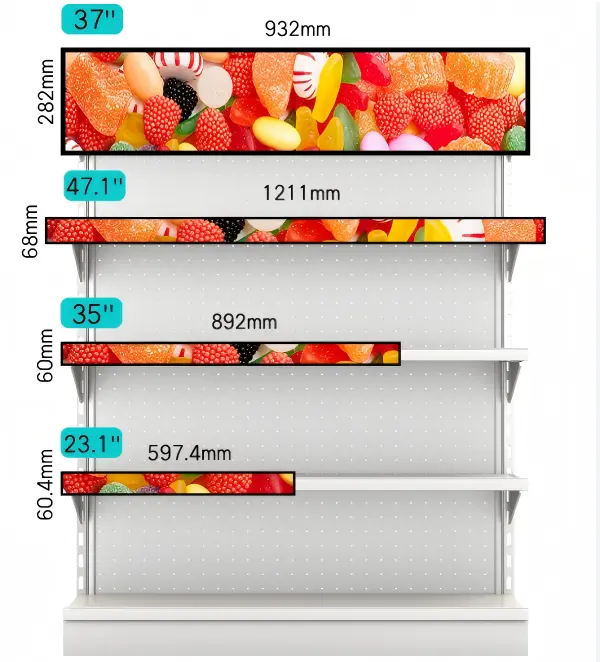
AplusLCD shelf edge displays are ultra-wide LCD screens built to sit directly on the retail shelf rail, replacing paper price tags, printed shelf talkers, and static promotional strips with live digital pricing. The format matters more than the screen: a bar only 60 mm tall occupies the narrow strip of space above the product without covering the merchandise beside it, which is why standard 16:9 signage never worked on a shelf. We stock four widths so the unit matches the bay instead of the other way round — 23.1" (597 × 60 mm outline) for 600 mm grocery and pharmacy bays, 35" (891.6 × 60.4 mm) and 37" (932 × 282 mm) for 900 mm bays, and 47.1" (1214.8 × 68.8 mm) for 1200 mm runs. All four are already running in supermarkets, convenience chains, electronics retailers, and pharmacies across North America, Europe, and the Middle East, where pricing updates are pushed from the POS or pricing server instead of being reprinted by hand.
Common Retail Shelf Edge Display Problems — and How We Specify Around Them
What we specify: Push prices straight from the POS or pricing server over the Android CMS, so a price change reaches the shelf without anyone walking the aisle. It also removes the shelf-versus-checkout price mismatch that draws regulatory attention in several markets.
What we specify: Use a bar format instead — the 23.1" (1920×158), 35" (3840×200) and 47.1" (3840×160) are all roughly 60-69 mm tall, so they sit on the rail without covering the facings above, while the 37" (1920×540) is a 932 × 282 mm half-height panel for bay headers and end caps. The format is what makes a screen survivable on a shelf rail.
What we specify: Match the outline width to the bay: 23.1" (597 mm) for 600 mm bays, 35" (891.6 mm) or 37" (932 mm) for 900 mm bays, and 47.1" (1214.8 mm) for 1200 mm runs. Send the bay width and rail profile and our engineers will confirm the fit before you order.
What we specify: We cut the glass in-house from 8.8" to 93.8" at any aspect ratio, so the unit is matched to your rail profile and available depth instead of forcing a redesign of the shelving. Send the rail profile and a photo of the aisle.
What we specify: Specify sealed cut edges. Unsealed edges are where moisture enters the panel, and that is the single most common failure in low-cost bar displays — it never shows up in a dry showroom trial.
What we specify: There is no MOQ: start with one sample to validate the rail fit and content rendering, then run a pilot of 10-50 units across one aisle or one store. Stock configurations ship in 10-15 days.
Why Retailers Are Replacing Paper Shelf Talkers
Paper shelf-edge labelling carries a recurring cost that is easy to underestimate: printing, distribution, and the labour of walking every aisle to swap tags, multiplied by every price change and every store. Electronic shelf edge displays remove that cycle entirely. When a price changes in the POS or pricing server, the shelf label updates with it, which also eliminates the mismatch between shelf price and checkout price that draws regulatory attention in several markets. Beyond pricing, the same screen carries promotional video, allergen and ingredient information, stock status, and QR codes that link to product detail pages — content a paper tag physically cannot hold. Retailers typically start with a single promotional aisle to measure uplift, then extend to full-store coverage once the labour saving is quantified.
Choosing Between the 23.1", 35", 37" and 47.1" Shelf Edge Sizes
The four stock widths differ in two ways that matter on a shelf: how much of the bay they cover, and how tall they are. The 23.1" (1920×158), 35" (3840×200) and 47.1" (3840×160) are all low-profile strips roughly 60-69 mm tall, so they sit on the rail without eating into the facings above — choose between them purely by bay width: 600 mm, 900 mm or 1200 mm. The 37" is the odd one out. At 932 × 282 mm it is a half-height panel rather than a strip, which is what you want where a readable price block has to sit alongside imagery: bay headers, end-cap panels and promotional positions with a deeper shelf edge. Brightness follows the same split — the 23.1" and 37" are 700-nit parts for general grocery and pharmacy lighting, while the 35" and 47.1" are 500-nit parts for shelves that sit away from spotlights. Where an aisle runs under spotlights or beside a window, we build the same four sizes up to 1500 nits.
Compare all four shelf edge display sizes and specificationsFitting a Shelf Edge Display to Standard Retail Rails
Shelf edge deployments are mechanical problems before they are display problems. The unit has to sit on the existing rail profile without protruding into the aisle, without blocking the product above it, and without a cable run that a restocker can snag. Match the screen to the bay rather than re-designing the shelving: the 23.1" measures 597 × 60 mm overall and drops into a 600 mm bay with clearance at both ends; the 35" at 891.6 × 60.4 mm covers most of a 900 mm bay while staying a true 60 mm strip; and the 47.1" at 1214.8 × 68.8 mm covers a full 1200 mm run in one piece instead of two butt-joined units. Where none of the four matches your rail, we cut custom sizes from 8.8" to 93.8" at any aspect ratio and seal the cut edges — unsealed edges are where moisture enters in chilled and fresh-food aisles, and that is the single most common failure in low-cost bar displays. Send us the rail profile and available depth, and our engineers will confirm the cut dimensions before tooling.
Content Management Across Multi-Store Rollouts
A shelf edge network is only useful if content can be changed centrally. We offer three models: USB auto-play for single-store trials, an external media player over HDMI for sites with an existing signage player, and a built-in Android mainboard with CMS for networked deployments. The Android route is what most rollouts use — it lets you schedule price and promotion changes by store, by aisle, or by time of day, push updates over the network, and confirm playback status from one dashboard instead of visiting sites. Pricing can be templated against your product master so that a price change flows to the shelf automatically rather than being re-keyed into a design tool.
Selection Parameters — What to Specify for Retail Shelf Edge
| Parameter | Specification |
|---|---|
| Shelf Bay Compatibility | 600 mm / 900 mm / 1200 mm bays 23.1" (597 mm outline) for 600 mm bays; 35" (891.6 mm) and 37" (932 mm) for 900 mm bays; 47.1" (1214.8 mm) for 1200 mm runs — one unit per bay instead of two butt-joined screens. |
| Stock Shelf Sizes | 23.1" / 35" / 37" / 47.1" Four stock widths kept for shelf-edge work; anything from 8.8" to 93.8" cut to order when the rail matches none of them. |
| Active Area (W×H) | 585.6×48.19 · 877.82×45.72 · 899.71×253.04 · 1196.16×49.84 mm 23.1" / 35" / 37" / 47.1" respectively. The 37" is the only half-height panel in the set, which is why it carries imagery as well as price. |
| Outline Dimensions (W×H) | 597×60 · 891.6×60.4 · 932×282 · 1214.8×68.8 mm Allow clearance at both ends of the bay and confirm the available depth behind the rail before specifying. |
| Aspect Ratio | 16:1.3 / 32:6 / any custom ratio The ratio is what lets the screen sit in the narrow strip above the product without covering the merchandise beside it. |
| Resolution | 1920×158 / 3840×200 / 1920×540 / 3840×160 Choose by content: 1920×158 is enough for price and promotion text, 3840×200 and 3840×160 for image-heavy brand content. |
| Brightness | 300-1500 NITS (500-700 typical shelf edge) 23.1" and 37" are 700-nit parts; 35" and 47.1" are 500-nit parts; 1500 under spotlights or near a window; 2500 for covered semi-outdoor. |
| Touch Options | PCAP or IR multi-touch (optional) Only worth the cost where shoppers interact — most price-only deployments are display-only. |
| Content Management | Android CMS, USB auto-play, or HDMI external player Android CMS is what makes multi-store rollouts manageable: template prices against the product master and push by store, aisle or time of day. |
| Minimum Order | No MOQ — 1 pc sample available Validate the rail fit on one aisle before committing to a store-wide rollout. |
Which AplusLCD Display Fits Your Retail Shelf Edge Project?
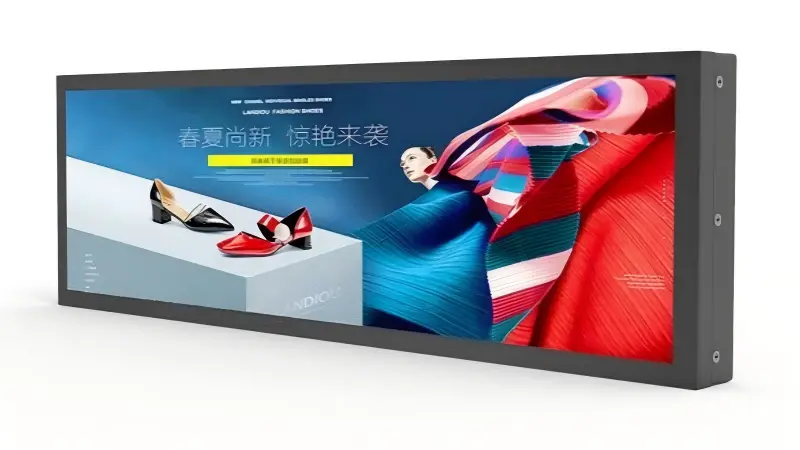
Four stock shelf widths — 23.1" (1920×158), 35" (3840×200), 37" (1920×540) and 47.1" (3840×160) — or cut to your rail profile at any ratio from 8.8" to 93.8".
View models & specifications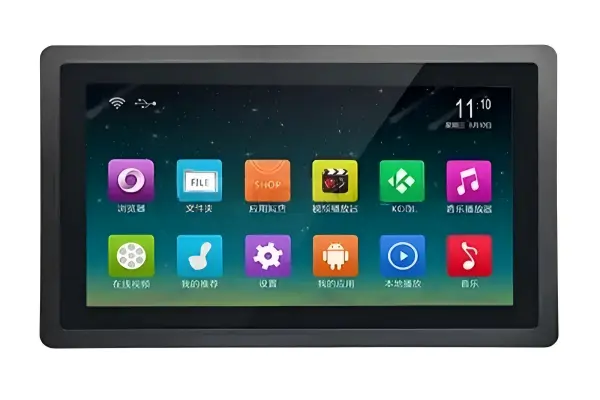
Built-in Android mainboard: push price and promotion changes by store, aisle or time of day from one dashboard.
View models & specifications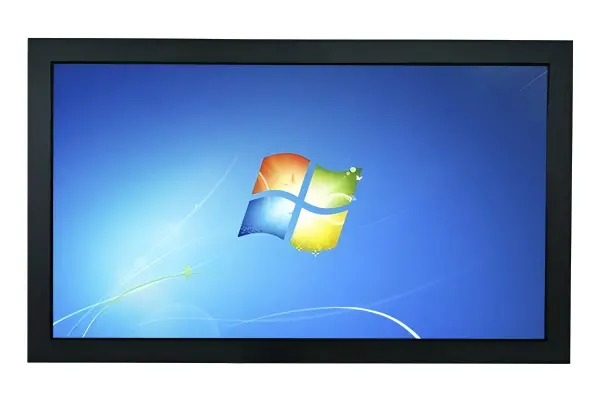
21.5" to 86" Full HD / 4K for promotional bays and end caps where a bar format is not enough.
View models & specifications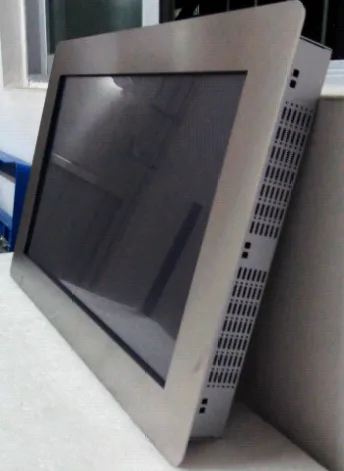
Cut to your rail profile and available depth with sealed edges for chilled and fresh-food aisles.
View models & specificationsNot sure which of these fits your retail shelf edge project? Send size, brightness, mounting method and site environment — our engineers return a configured quotation with pricing and lead time within 24–48 hours.
Request a QuoteApplications
Related Industry Applications
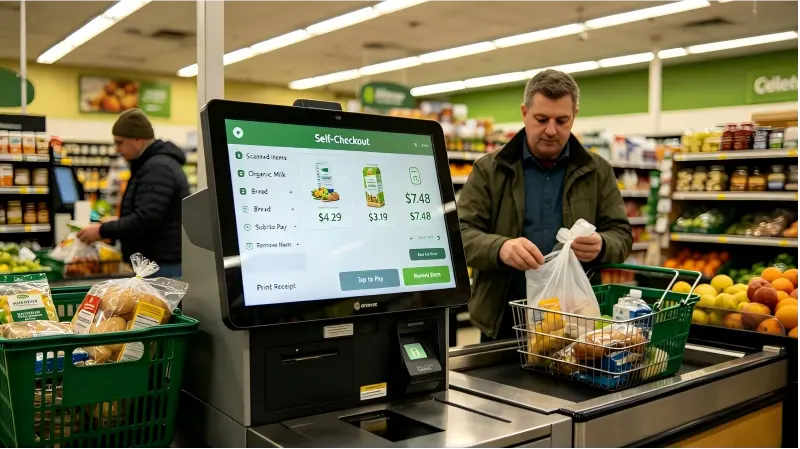
Slim, reliable display solutions for point-of-sale terminals, customer-facing screens, electronic shelf labels and retail digital signage. Android or Windows platform support.
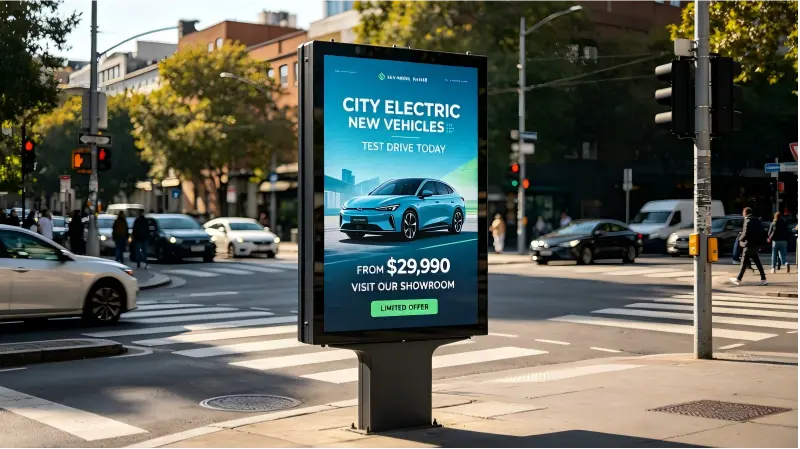
Eye-catching large-format displays for digital OOH advertising, retail wayfinding, menu boards and dynamic content. Stretched bar LCDs and transparent LCDs for creative installations.
Frequently Asked Questions
Which of the four shelf edge sizes fits a 600, 900 or 1200 mm shelf bay?
Match the outline width to the bay. The 23.1" measures 597 × 60 mm overall and is the stock fit for a 600 mm grocery or pharmacy bay. The 35" (891.6 × 60.4 mm) covers most of a 900 mm bay while staying a 60 mm-tall strip. The 37" (932 × 282 mm) also suits a 900 mm bay but is a half-height panel rather than a strip, so it is used on bay headers, end caps and deeper shelf edges where imagery sits beside the price block. The 47.1" (1214.8 × 68.8 mm) covers a full 1200 mm run in one piece. Send us the bay width and rail profile and we will confirm the fit before tooling.
What is the difference between a shelf edge display and an electronic shelf label (ESL)?
An electronic shelf label is a small e-paper tag that shows price only. A shelf edge LCD display is a full-colour video screen that shows price, promotion, imagery, and video, and is typically used on promotional bays, end caps, and category headers rather than on every single facings position. Many retailers run both: ESLs for per-item pricing, shelf edge LCDs for promotion and brand content.
Can shelf edge displays update prices automatically from our POS?
Yes. With the built-in Android mainboard and CMS, prices can be templated against your product master and pushed over the network, so a price change in the POS or pricing server flows to the shelf without manual re-keying. For simpler deployments, USB auto-play and external media players are also supported.
Are 500-700 nits bright enough for supermarket lighting?
For indoor retail under standard fluorescent or LED ceiling lighting, yes — 500-700 nits covers our four stock shelf edge sizes and keeps price text legible at normal shopping distance. We specify up to 1500 nits where the shelf sits under spotlights or near a window, and a 2500-nit option for covered semi-outdoor positions.
What is the minimum order for a shelf edge display rollout?
There is no minimum order quantity. Most retailers start with a single sample to validate the rail fit and content rendering, then run a pilot of 10-50 units across one aisle or one store, and only then commit to volume. Stock configurations ship in 10-15 days.
Can you match the display to our existing shelving profile?
Yes. Send us the rail profile, available depth, and the aisle photograph, and our engineers will confirm the cut dimensions and mounting method. Because we cut the glass in-house, custom sizes from 8.8" to 93.8" at any aspect ratio are available without the lead time of a fully new tooling programme.
Can shelf edge displays run video and animation, not just price?
Yes — these are full-colour LCDs, so the same screen carries price text, promotional video, allergen and ingredient information, stock status and QR codes. Most retailers template the price block and schedule promotional video around it from the CMS.
How do we power and connect a run of shelf edge displays?
Most deployments run a low-voltage rail or daisy-chained power strip along the shelf. With the Android mainboard you also need data, normally provided over Wi-Fi to each unit or a wired run per bay. Send the aisle layout and we will confirm the power and data approach before you commit.