Industrial displays for EV charging stations can fail buyer expectations when selection starts with a brightness number instead of the installation site. A screen that looks clear indoors may become reflective, overheated, or difficult to read at the charger. I recommend treating display selection as a system-level engineering decision.
Industrial displays for EV charging stations should be selected according to sunlight direction, mounting angle, enclosure heat, duty cycle, user interaction, and service-life requirements. Brightness matters, but it cannot solve reflection, poor thermal design, unsuitable cover glass, or an enclosure that traps heat during continuous outdoor operation.
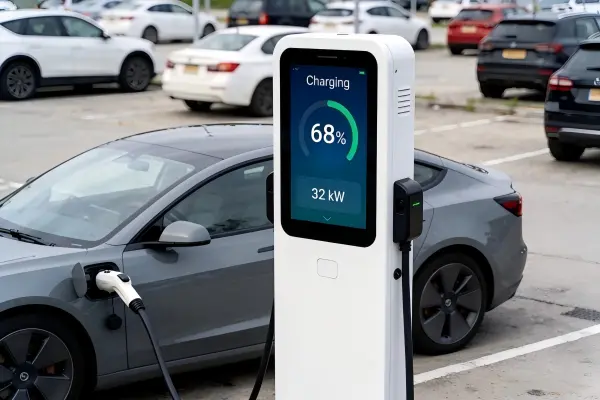
I have supported specification discussions for EV charger and outdoor self-service projects where the display itself was only one part of the problem. The most useful early questions were often about the charger’s physical location, screen orientation, canopy design, and daily operating conditions.
How Should Industrial Displays for EV Charging Stations Start With the Site?
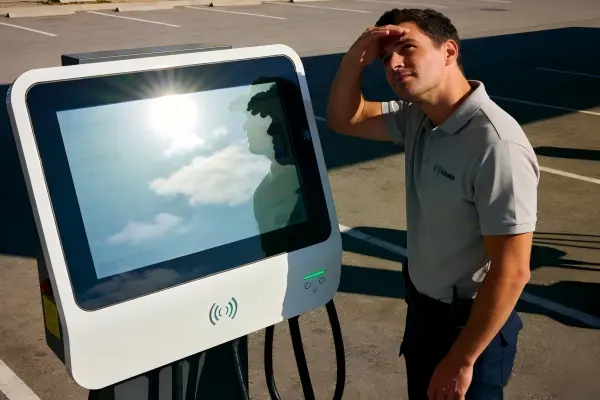
A charger OEM may request a 1,500-nit or 2,500-nit screen because the unit will be installed outdoors. That request can miss the real risk. Direct afternoon sun, a forward-facing glass surface, and an upward mounting angle can still create poor readability and heat stress.
Industrial displays for EV charging stations should begin with a site assessment that identifies sun direction, shading, mounting geometry, ambient temperature, and user viewing distance. These factors determine whether brightness, anti-glare treatment, optical bonding, enclosure ventilation, and screen orientation will work together.
Ask Questions Before Choosing Nits
I recommend that engineers map the display’s exposure before finalizing the panel specification. A brightness rating is measured under controlled conditions.[1] The charging station will operate in changing weather, different seasons, and varying sun angles.
Key questions include:
- Which direction will the display face: north, south, east, or west?
- Does direct sun hit the screen in the morning, afternoon, or throughout the day?
- Will a canopy, building, vehicle, or tree provide partial shading?
- Is the screen vertical, tilted upward, recessed, or flush with the enclosure?
- Will users view the interface at close range or from several steps away?
- What is the expected maximum local ambient temperature?
- Does the charger operate continuously, including during peak daytime heat?
In our anonymized sample-stage discussions, screen orientation often changed the recommended solution more than resolution did. A display that sits behind a deeply recessed front bezel may receive less direct light, but the same recess can reduce airflow and increase internal temperature.[2] An angled screen may improve user ergonomics, but it can also reflect the sky or sun.
Match the Display to the User Task
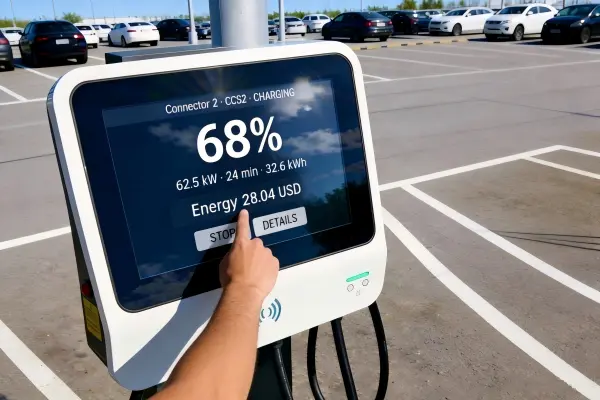
The required readability level also depends on what the driver must do. A large status screen showing charging progress may remain usable with more moderate contrast than a payment or authentication interface that requires users to read small text, scan QR codes, or confirm pricing.
| User task | Primary display risk | Specification focus |
|---|---|---|
| Charging status | General visibility | Brightness, viewing angle, font size |
| Payment confirmation | Missed small text | Contrast, anti-glare glass, UI design |
| QR code scanning | Reflections on code area | Screen placement, glare control |
| Touch interaction | Inaccurate inputs | Touch performance, wet-use behavior, bezel design |
| Fleet or operator interface | Continuous operation | Thermal design, lifecycle supply, serviceability |
I would avoid selecting a screen solely because it has the highest listed luminance. The better decision is the display-and-enclosure combination that supports clear user interaction at the actual installation site.
What Makes Industrial Displays for EV Charging Stations Readable Outdoors?
Outdoor readability is often reduced to “more nits,” which is incomplete. High luminance can improve visibility, but reflected sunlight, cover-glass glare, poor contrast, and wide-angle viewing conditions can still make a bright screen difficult to use.[3]
Industrial displays for EV charging stations remain readable outdoors when luminance, contrast, anti-reflection or anti-glare treatment, cover glass, viewing angle, interface design, and enclosure geometry are evaluated together. No single brightness rating guarantees sunlight readability at every charging location.
Brightness Is Only One Layer
A high brightness LCD monitor may be appropriate for exposed charging stations, especially where users must read detailed information in daylight. However, extra backlight power also creates more heat.[4] The enclosure must remove that heat without introducing dust, water, or maintenance problems.
I usually frame outdoor readability as the relationship between five factors:
- Display luminance: Higher luminance can improve the screen image against strong ambient light.
- Surface reflections: Clear cover glass may reflect the sky, vehicles, or the user’s clothing.
- Optical treatment: Anti-glare, anti-reflection, and optical bonding options can reduce perceived reflections[5], although each option should be assessed for image quality, cost, and integration.
- Viewing geometry: A screen can appear clear when viewed straight on but wash out at a user’s natural standing angle.
- UI design: Large typography, high-contrast colors, simple action flows, and readable status indicators reduce dependence on raw screen brightness.
Consider Cover Glass and Touch Stack-Up
For a touch-enabled charger, the final optical stack includes more than the LCD. It may include a touch sensor, adhesive layer, cover glass, printing, gasket, and front enclosure. Each layer can affect reflectivity, haze, transmission, and heat transfer.
| Design choice | Potential benefit | Evaluation point |
|---|---|---|
| Anti-glare glass | Reduces harsh mirror-like reflections | Check haze and perceived sharpness |
| Anti-reflection coating | Can improve contrast in bright conditions | Verify durability requirements |
| Optical bonding | May reduce internal reflections | Assess repair process and cost |
| PCAP touch | Supports modern multi-touch UI | Confirm wet, glove, and water behavior[6] |
| Recessed screen | Can reduce direct exposure | Check viewing angle and heat buildup |
A practical sample evaluation should include the intended cover glass and touch assembly. A bare panel review in an office is not enough. I recommend reviewing a prototype under the highest-risk conditions available, such as direct sun and elevated ambient temperature. This does not replace formal environmental qualification, but it can reveal integration risks before mass production.
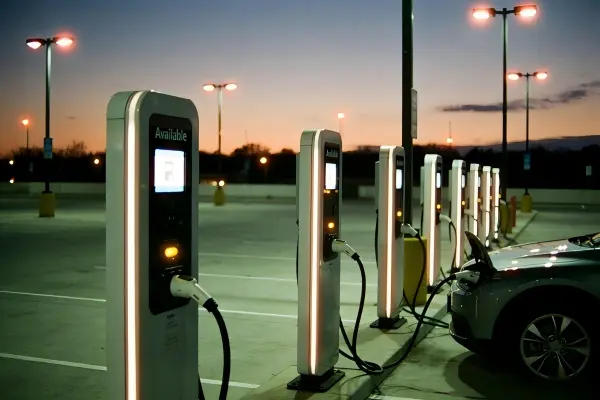
Can Commercial Displays Work in EV Charging Stations?
Commercial displays can be suitable for some charging applications, particularly sheltered units, indoor installations, or deployments with limited daily operating hours. However, an outdoor enclosure does not automatically transform a commercial product into a reliable 24/7 charging-station display system.[7]
Commercial displays may work in selected EV charging stations, but OEMs should assess duty cycle, backlight life, internal heat, component temperature limits, supply continuity, and service requirements. Industrial displays for EV charging stations are typically evaluated for stability across demanding operating conditions, not only image quality.
Evaluate the Complete Thermal Path
The key question is not whether the display fits physically inside the charger. The question is whether the LCD, backlight, controller board, power supply, touch components, and enclosure can remain within their intended temperature limits.
Heat may come from several sources:
- Direct solar loading on the front glass and metal housing
- High-brightness backlight power consumption
- Internal charger electronics
- Limited air circulation in sealed enclosures
- Dark enclosure finishes that absorb heat
- High ambient temperature at the deployment location
A screen can appear normal during a short indoor demonstration and still face risks in a hot outdoor cabinet. These risks may include reduced brightness, image artifacts, shortened backlight life, touch instability, or component stress.[8] I would not describe an IP rating[9], an “industrial grade” label, or a certification document as complete proof of system-level outdoor reliability. Buyers should verify the relevant documents and confirm how the final integrated charger will be qualified.
Build a Low-Risk Validation Plan
For charger OEMs, sample validation should focus on the conditions most likely to create complaints after installation.
I recommend testing the final or near-final display stack in the intended enclosure whenever possible. The goal is to identify avoidable integration issues before tooling and volume procurement.
A focused validation plan can include:
- Readability checks during direct and indirect daylight
- Viewing-angle review from normal user standing positions
- Thermal measurement inside the operating enclosure
- Continuous-operation checks at elevated temperature
- Touch testing with dry hands, gloves, water droplets, or rain exposure where relevant
- Mechanical checks for sealing, vibration, cable routing, and front-glass retention
- Supplier review for panel availability, revision control, and replacement planning
At AplusLCD, we can support specification confirmation, sample preparation, and manufacturing discussions for customized display assemblies. For application-specific electrical, thermal, and regulatory decisions, I recommend using qualified engineering and compliance professionals.
Frequently Asked Questions
What brightness is best for an EV charging station display?
No single brightness level is best for every location. The right level depends on direct sun exposure, mounting angle, cover-glass reflections, UI content, and enclosure temperature. I recommend assessing the site before selecting a high-brightness display.
Does an IP65 enclosure make a display suitable for outdoor EV chargers?
No. An IP rating primarily addresses ingress protection under defined test conditions. It does not independently confirm sunlight readability, internal thermal performance, 24/7 duty capability, backlight life, or the reliability of the complete charger system.
Should EV charger displays use optical bonding?
Optical bonding can reduce internal reflections and may improve perceived outdoor readability. However, OEMs should evaluate its cost, repair process, optical appearance, thermal behavior, and compatibility with the selected touch and cover-glass structure.
Can a commercial LCD be used in a charging station?
A commercial LCD may be appropriate for sheltered, indoor, or lower-duty applications. For sun-exposed and continuously operating stations, engineers should carefully evaluate temperature limits, backlight lifetime, component stability, and long-term supply requirements.
Conclusion
Industrial displays for EV charging stations should be selected as part of the complete charger system, not as an isolated screen specification. I recommend starting with sunlight exposure, shading, screen angle, user tasks, and enclosure thermal conditions. Then, evaluate brightness, optical treatment, touch technology, duty cycle, and supplier continuity together. If you are developing a charger display assembly, AplusLCD can help you review specifications, prepare samples, and build a customized industrial display solution for your enclosure.
Footnotes
-
"Energy Efficiency Program: Test Procedure for Televisions", https://www.federalregister.gov/documents/2010/09/03/2010-22066/energy-efficiency-program-test-procedure-for-televisions-request-for-information-and-request-for. Display luminance specifications are generally obtained under defined test conditions prescribed by measurement standards, so they do not by themselves represent readability in a particular outdoor installation. Evidence role: definition; source type: institution. Supports: Standardized display luminance measurements are conducted under specified test methods and conditions.. Scope note: The applicable test method depends on the display category and manufacturer specification. ↩
-
"Evaluation of Cooling Solutions for Outdoor Electronics", https://arxiv.org/pdf/0801.1043. Thermal analyses of outdoor electronic enclosures show that solar loading and restricted convective airflow can materially increase internal component temperatures. Evidence role: mechanism; source type: research. Supports: Enclosure geometry, solar radiation, and ventilation influence the heat balance and internal temperature of outdoor electronic equipment.. Scope note: The thermal effect of a particular recessed bezel depends on its dimensions, materials, heat sources, and ventilation design. ↩
-
"Effects of ambient illumination, contrast polarity, and letter ...", https://pubmed.ncbi.nlm.nih.gov/28166901/. Research on display visibility under high ambient illumination finds that reflected glare and contrast degradation can limit legibility even where display luminance is increased. Evidence role: general_support; source type: paper. Supports: Ambient illumination, reflected glare, contrast, and viewing conditions jointly influence display readability.. Scope note: Measured readability varies with display technology, surface treatment, content, ambient illumination, and observer conditions. ↩
-
"Thermal management of high-power LEDs", https://en.wikipedia.org/wiki/Thermal_management_of_high-power_LEDs. Thermal-management literature on LED backlights documents that electrical input not converted to emitted light is dissipated as heat, increasing the need for effective heat removal at higher operating power. Evidence role: mechanism; source type: paper. Supports: Electrical power consumed by LED/LCD backlight systems is partly dissipated as heat and affects thermal design.. Scope note: The amount of added heat depends on backlight efficiency, drive level, panel construction, and ambient conditions. ↩
-
"Anti-Reflective Coatings Produced via Atomic Layer ... - PMC", https://pmc.ncbi.nlm.nih.gov/articles/PMC10458567/. Optics literature explains that anti-reflection treatments reduce surface reflectance, while optical bonding can reduce reflections associated with refractive-index discontinuities at internal air gaps. Evidence role: mechanism; source type: paper. Supports: Surface treatments and reduction of air interfaces can reduce reflected light in display assemblies.. Scope note: Anti-glare surfaces may trade lower mirror-like reflection for increased haze, and results depend on the complete optical stack. ↩
-
"Review of Capacitive Touchscreen Technologies - PMC - NIH", https://pmc.ncbi.nlm.nih.gov/articles/PMC8309784/. Research on projected-capacitive touch sensing reports that water and insulating glove materials can alter capacitive signals, making performance validation under intended use conditions important. Evidence role: general_support; source type: paper. Supports: Water films and gloves can affect capacitive touch sensing and may require design or firmware adaptation.. Scope note: Performance depends on sensor design, controller algorithms, glove material, water quantity, grounding, and enclosure construction. ↩
-
"A Status Review of Photovoltaic Power Conversion ...", https://www.osti.gov/servlets/purl/1405276. Environmental-qualification guidance treats temperature, humidity, solar exposure, ingress, vibration, and operating duty as system-level stresses that must be evaluated for the assembled equipment. Evidence role: general_support; source type: institution. Supports: Environmental and reliability qualification evaluates the integrated equipment under relevant operating stresses rather than inferring suitability from enclosure placement alone.. Scope note: Qualification requirements and test severities must be selected for the product's intended environment and applicable regulatory framework. ↩
-
"An Accelerated Test Method for Predicting the Useful Life ...", https://dspace.rpi.edu/server/api/core/bitstreams/704d303b-76c0-4eb6-b67c-cb08ab3d48de/content. Reliability studies of LEDs and display-related electronics identify elevated junction and operating temperatures as factors that can reduce light output and accelerate degradation processes. Evidence role: mechanism; source type: paper. Supports: Elevated operating temperature can affect display optical performance and accelerate degradation mechanisms in LEDs and electronic components.. Scope note: Specific artifacts, lifetime effects, and touch behavior depend on the panel, backlight, controller, materials, and actual thermal profile. ↩
-
"IP code", https://en.wikipedia.org/wiki/IP_code. IEC 60529 defines IP codes as classifications of enclosure protection against access, solid foreign objects, and water under specified test conditions. Evidence role: definition; source type: institution. Supports: IEC 60529 defines IP codes in relation to protection against access, solid foreign objects, and water under prescribed tests.. Scope note: An IP classification does not by itself assess all environmental, thermal, optical, or lifetime characteristics of an integrated charger. ↩